Members of the group are often to be discovered taking photographs. Here are some of the results.
Theophilus Chain
Theophilus Chain - An image of the moon from Chris Lee. The image was taken in mid 2023 from Alveston.


M101 Supernova in May 2023
M101 SupernovaMessier 101 (the Pinwheel Galaxy) near the foot of the handle in The Plough is quite high in our skies at present. Yesterday (May 20th) a supernova was discovered in its outer spiral arm and a quite bright one at that. Chros Lee took an image but it may be bright enough for a small telescope. Worth a look before it fades...

Photographs from April 2022
Here are some examples of the range of images we can now address with “local kit”.


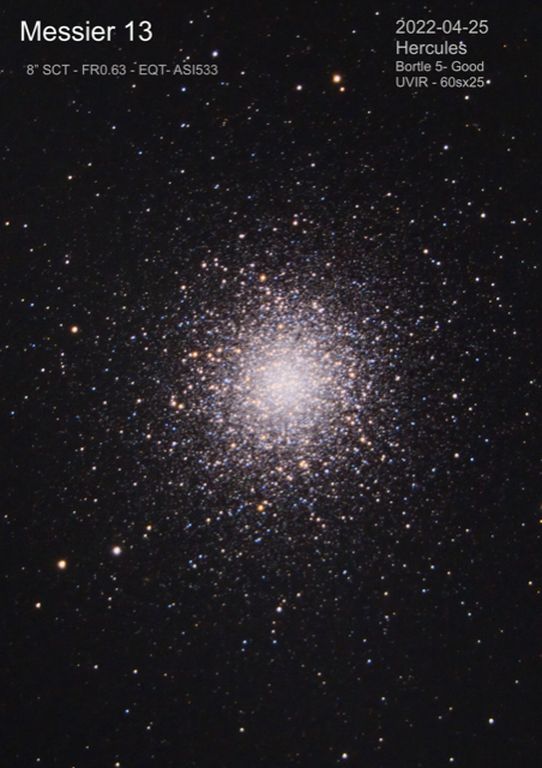


Group
Horsehead and Flame nebulae
In January 2022, Bill Beere used an 80mm refractor to take this image of the Horsehead and Flame nebulae.

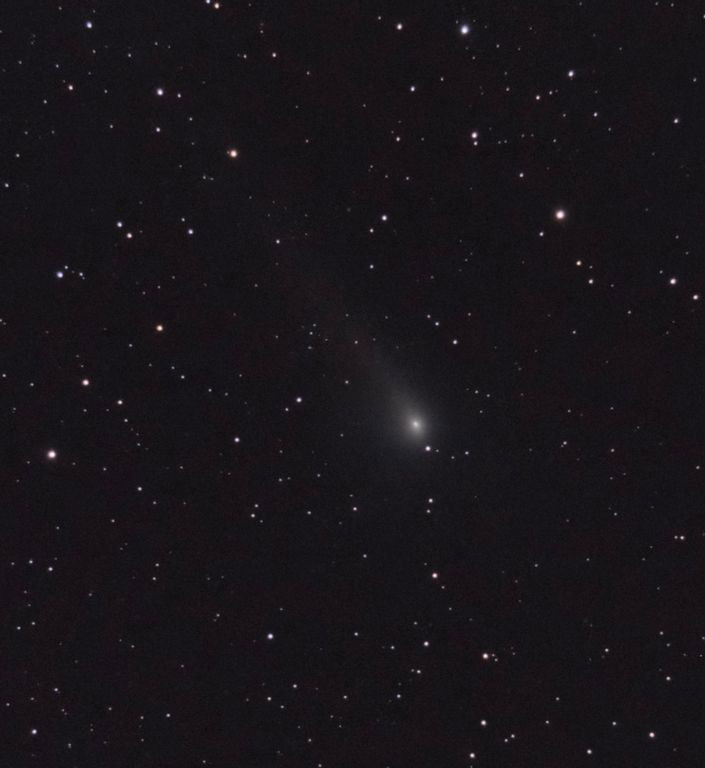
Comet 67P by Chris Lee
Chris Lee got a very nice shot of comet 67P/C-G. Photo shows the comet identified by its tail.The comet was at its closest approach to the sun on November 3rd. That was close enough for it to develop a nice tail.
Andromeda Galaxy by Brian McBride
Brian reports:
"About a year ago, at night, I pointed my camera with a wide-angle lens attached straight up and took a few snaps. After processing the images I noticed this little fuzzy patch that reminded me of a galaxy. Turned out to be Andromeda. So I tried pointing a telephoto lens at it and after a few months of intermittent trial and error ended up with the attached. No fancy astro gear - just a camera, a 200mm lens and a tripod - and some software. Since then I've got some poor but recognisable images of the Pinwheel galaxy, Bode's + cigar galaxies and the North America nebula and surrounds.
"No doubt this is a path that many have walked before, but I am, frankly, smacked around the face with a wet piscis, that anyone can point an ordinary camera and lens at the night sky and produce recognizable images of galaxies and nebulae. Who would have thunk it.
"It was shot with an unmodified Canon EOS R mirrorless camera and f4 70-200 mm lens on a tripod in a field just outside Old Down. It’s a merge of about 1500 two second exposures stacked using free software and then prepared for presentation in Photoshop."
Brian also gives the following as one of his reasons for joining the group:
"I have been blundering around on my own for about a year and will likely continue along this path for a bit, but I thought I'd try to find some like-minded souls who might help me with this new-found interest and have knocked on the obvious door. It’s a beginner’s image, but it shows the sort of thing that even ordinary digital cameras are capable of."

Drawings of Mars by Chris Lee
Not everyone takes photographs. Chris Lee is one of the remaining practitioners of the art of sketching at the telescope. He did these sketches of Mars during its opposition in October 2020.


Photograph of Mars by Malcolm Worster
Malcolm's telescope is a Meade LX90 10 inch Schmidt-Cassegrain with a focal length of 2500mm. His camera is a Meade Lunar Planetary Imager (a CCD camera much like a webcam) which is probaby 10-15 years old so fairly basic compared to what is available now.
He took the picture on October 23rd 2020 from his back garden in Tockington.
Various freeware programs were used to capture and process the image. They all have a multitude of settings which Malcolm just guessed at.:
- Firecapture was used to capture the image as an AVI video file approx 30 secs long;
- Autostakkert was used to select the best frames and to stack them together to produce a TIFF file;
- Registax Image Processing Software to manipulate the image and make it sharper.
Malcolm suggests that other members of the group may be more familiar with these and more knowledgeable on to how to use them.

Chris Lee - The Perseids
The Perseids meteor shower peaked in the middle of August. Chris Lee has sent a digitised drawing of the traces he observed from his back garden on Tuesday evening, August 11th.

Chris Lee - Grand Tour
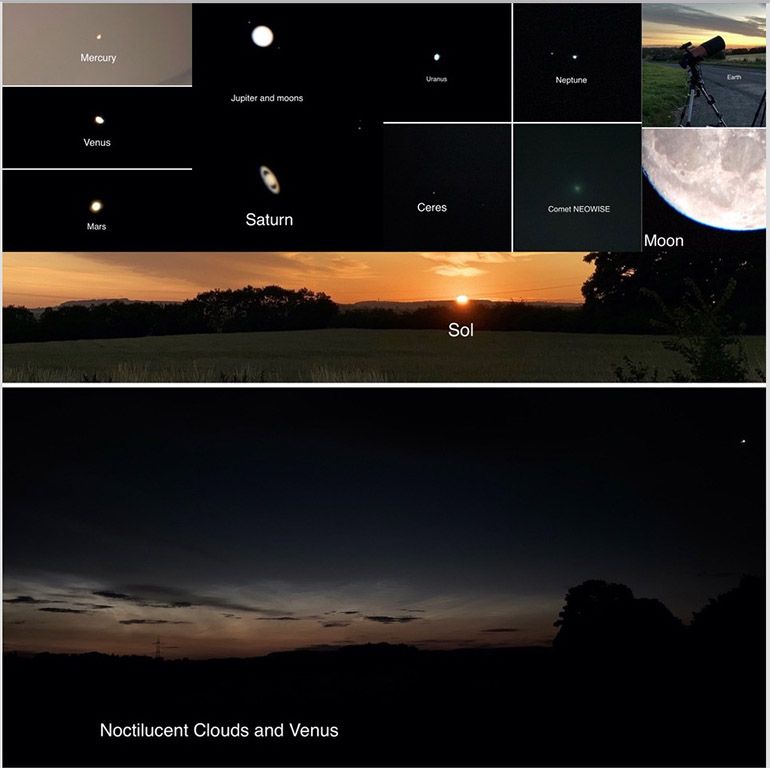
All the planets are visible in the night sky at the moment and some of you are taking advantage of this. Chris Lee bagged the lot, and more, in one night. Over the night of August 1st he shot what he described as all the key objects in the Solar System at present.
These consisted of: all eight planets (he included Earth – a stickler for detail is Chris), the Sun, the Moon, Comet Neowise and asteroid Ceres. And he then threw in a nice shot of Venus above Noctilucent clouds for good measure.
Chris did all of this from a lay-by on a little-used section of the B4061 (Old Gloucester Road) just below The White Horse pub on the A38. He later dscribed the adventure:
"For info the observing run for the Planets etc began at 11:30 pm in order to get set up for the setting comet, moved on to the Moon, Jupiter and Saturn where I spent bit of time sketching but seeing not brilliant. Early hours then saw me move cross to Neptune, Ceres, Uranus and Mars and was all finished in the main by 3:00 am while I then waited for Venus and Mercury to rise. Rather twiddled my thumbs for an hour. Luckily the Noctilucent Clouds presented a welcome distraction (and a surprise). At one point I thought they might even prevent Mercury from being seen but they faded away by 4:00. Picked off Venus, then Mercury and by then I had decided to wait for sunrise at 5:30 to complete the set..."
Bob Dale - Jupiter and its Moons
Here is an image by member Bob Dale, taken on July 25th. It’s a shot of Jupiter and its four Galilean Moons. You may think this shot is a bit blurred, but consider how he took it. He has a Lumix bridge camera. He simply mounted this on a tripod as it was – nothing extra fitted on the front - wound up the optical zoom to its maximum (x24) and used a ¼ second exposure. He had to do a bit of post processing to get rid of the sensor noise at that magnification, but he got all of the moons: two of them are very visible on the left, one is close to Jupiter’s limb on the right, and the fourth, Calisto, is very faint on the far right.


Bill Beere's Photographs
In March 2020, one of our members, Bill Beere, managed to image comet PANSTARRS.
In his image it is a dot with a blue halo on the right, a little over halfway up from the bottom. Here are the images. First is Bill's Skysafari image taken from his ipad marked up with a rectangle showing the extent of the image viewed through the camera given the sensor size and focal length of the lens. Second is the Bill's image. Finally is an image showing the location of the comet.

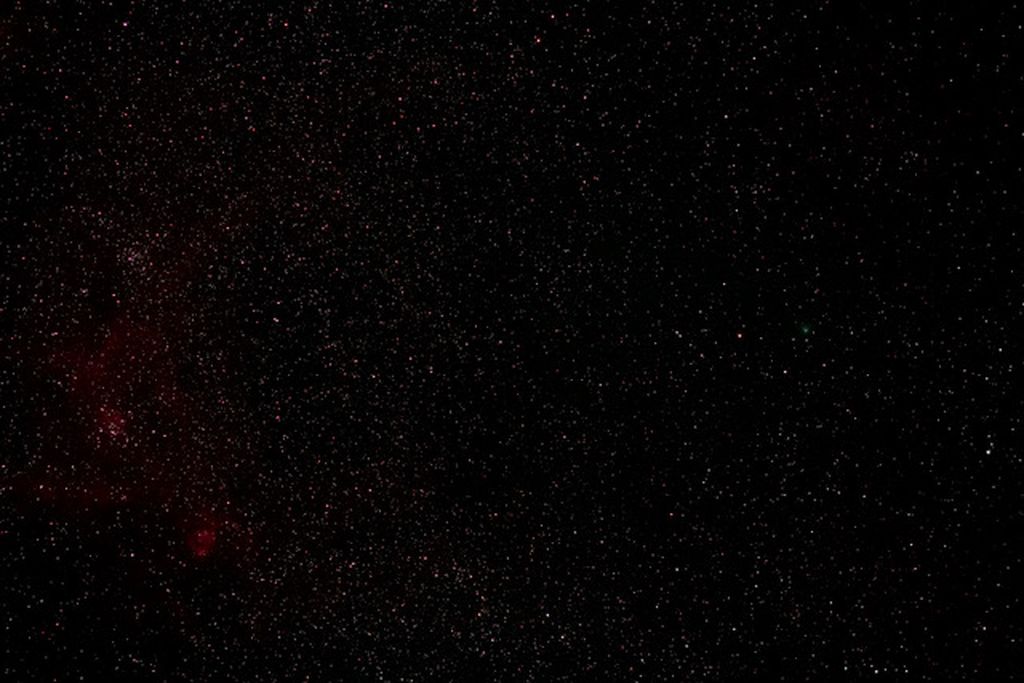

Bill used the most basic Skywatcher equatorial "Go To" mount and inexpensive Canon camera with a secondhand manual focus Nikon 180mm f2.8 lens. The Skysafari app on his iPad showed where the comet was in the sky. Bill took 64 frames at 30s f2.8 ISO 1600. The comet could be seen in each frame but at 1600 ISO there was quite a bit of noise.
The images were processed by aligning the stars in each and then averaging all frames to reduce the noise using Photoshop. The background light pollution was also subtracted as much as is possible. The overall picture is similar to what was expected from Skysafari except for the comet's tail - a smudge was all Bill could manage.
The tracking was good enough to see faint stars well below magnitude 14 (the limit available in Bill's copy of Skysafari). The red at one end of the image is part of IC 1805 The Heart Nebula. The Soul Nebula is alongside but Bill could not image both and the comet with a 180mm lens.
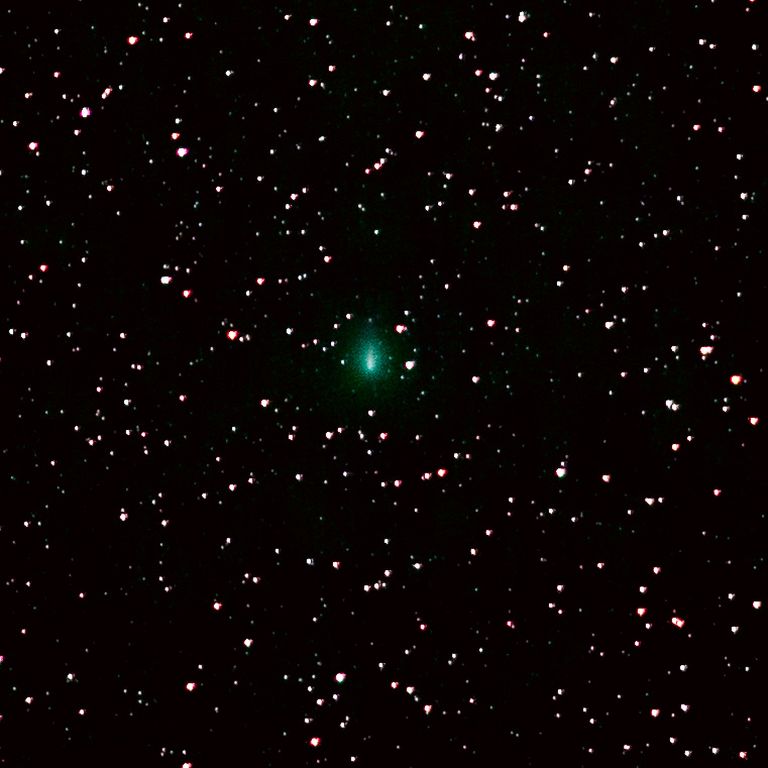
In April, Bill was out again with his camera looking for Comet ATLAS from his garden in Alveston. Bill had a certain amount of difficulty finding it because it was not near any obvious marker in the sky – he finally found it between the Pole Star and Capella, which are over 40 degrees apart. Later, Bill discovered that ATLAS was breaking up. In fact it appears that it began breaking up a few days before Bill’s shot, so what he caught is a comet in the process of disintegrating.
Bill was out again at the end of April and captured some star trails arcing round the north celestial pole The image is made from 15 four minute exposures. An enlargement of the center shows the offset of Polaris from the pole. In the photo, Polaris is at about 8 o'clock slightly offset by about three-quarters of a degree from true North. To emphasise this, Polaris is circled in the blown-up shot.

